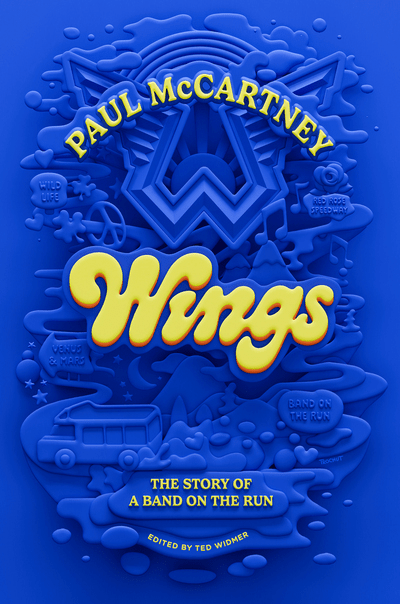
Title: Wings: The Story of a Band on the Run
Author: Paul McCartney
Editor / Introduction: Ted Widmer
Publisher (U.S.): Liveright Publishing (W.W. Norton & Company)
Publisher (U.K.): Allen Lane (Penguin Books)
Publication Date: November 4, 2025
Page Count: Hardcover: approximately 560–580 pages (edition dependent)
Audiobook Length: 19 hours and 6 minutes
ISBN (Hardcover): 978-1324096306
Paul McCartney recently released a book on Wings, my favorite post-Beatles project from any of the four. I am particularly a fan of Back to the Egg, as discussed in my previous post. This book was released on November 4, 2025. Limited quantities of Wings vinyl slipmats were given away with purchases of the book at Barnes and Noble.

For any Beatlemaniac, this is a must-read. Wings seems to be experiencing a resurgence in recent years, and I am loving every minute of it. Paul McCartney himself noted that Wings “found its moment.” Long overdue, maybe, but at least people are finally starting to realize the genius of Paul’s post-Beatle career.
This book is available as a hardcover and audiobook. I bought both. I listened to the audiobook, but the hardcover includes photographs and archival materials that the audio version simple cannot capture. It was worth it to have both.
Most Memorable Moments
Bloody Sunday and Give Ireland Back to the Irish
Paul’s discussion of Bloody Sunday and the writing of Give Ireland Back to the Irish is one of my favorite parts of the book. Compared to John Lennon, Paul is not usually viewed as a political figure. But the speed with which he wrote this song after the tragedy makes it clear that he was not only interested in writing silly love songs. When British soldiers opened fire on unarmed protesters, Paul knew it was wrong and felt compelled to respond. He understood immediately that the song would be banned and that it would cost him airplay. He accepted those consequences and released it anyway.
Keeping the Family Together on Tour
Paul spends a significant amount of time explaining why he made it a priority to keep his family together while touring with Wings. After the Beatles, separation felt unhealthy to him. Instead of treating touring as something that required long stretches away from home, he structured it so his children were always present. They came to rehearsals, shows, and arenas. Touring was built around family life rather than the other way around. He is clear that this was a conscious decision. Being together mattered more to him than convenience, efficiency, or appearances.
Paul and Linda’s Shared Wardrobe
Mary McCartney describes growing up in a household where her parents shared a wardrobe, and how that influenced her eventual fashion career. Paul and Linda regularly shared jackets, shirts, and other clothes. Clothes were not treated as belonging to one person. They had one huge closet that they both chose clothes from. She regularly saw her parents wearing each other’s clothes, and it was never framed as unusual – it was just normal. Growing up around Paul and Linda shaped her sense of style, and played a huge role in her success as a fashion designer.
Letting a Band Member Go Without Conflict
Another memorable moment for me was Paul’s response when Denny Seiwell, Wings’ original drummer, decided he wanted to leave the band. This happened during the Band on the Run sessions in Lagos in 1973, after the lineup had already been reduced and conditions had become increasingly difficult. Seiwell realized he did not want to continue and just wanted to go home. When he told Paul, there was no argument and no attempt to change his mind. Paul accepted the decision immediately and the band moved on. Paul was matter-of-fact about it. He did not describe the departure as a betrayal or a failure. There was no sense of resentment. He understood that people reach their limits. Rather than trying to hold the band together, he allowed the exit to happen cleanly. Wings continued as a smaller unit, and Band on the Run was completed without a drummer, with Paul handling drums himself.
My Thoughts
There has long been speculation that Paul’s early solo and Wings work was not well received at the time because the world was still raw from the breakup of the Beatles. Paul’s music did not dwell in that grief the way John’s and George’s work often did. Instead, he moved forward. People were still grieving, and perhaps they weren’t ready.
Now, with the release of Let It Be and Get Back, we can finally see how fractured those relationships actually were. The idea that Wings somehow represented a lesser version of the Beatles feels like an insult to the true genius of the artists behind the albums. Wings was Paul doing exactly what Paul should have done as the rockstar that he is: move on, build something new, trust his instincts, and soar.
Wings deserves to be understood on its own terms, not as a footnote or a consolation prize for Beatles fans. Without explicitly saying so, this book makes the case clearly that Wings’ moment is long overdue.


Leave a comment